

Microsoft is a multinational technology corporation, founded in 1975 by Bill Gates and Paul Allen. Microsoft develops, licenses, and sells software, hardware, and services to help individuals and businesses reach their full potential.
As a global leader in technology, Microsoft’s mission centers on empowering people and organizations through innovative technology that transforms how they work, play, and communicate.
The Challenge
One of Microsoft’s primary goals is to enable their workforce to deliver new work by enhancing skills through more efficient content development and training. With the adoption of AI, the business is testing, refining, and changing processes to streamline talent development.
Microsoft partnered with GP Strategies to explore how Learning Content AIQ (AIQ), a secure, agentic AI-platform, could help drive efficiency across its operations. Through targeted pilots, Microsoft identified two high-impact opportunities where AIQ delivered immediate, measurable value:
- Improving data hygiene and tagging: Making existing learning data AI-ready and unlocking the full potential of AI tools and systems.
- Scaling access to expert knowledge: Sharing knowledge across the workforce and using that knowledge to create dynamic new modalities for learning delivery.
AIQ is built on Microsoft technology, integrating seamlessly with tools like SharePoint, Teams, and Power Automate. This makes it a critical enabler in Microsoft’s strategy to unlock smarter and faster ways of working.
Driving Efficiency with AIQ: Two Strategic Applications
Enhancing Learning Experiences Through Data Hygiene and Tagging
Microsoft’s existing learning data was fragmented, inconsistently tagged, and poorly understood by AI systems. Without clean, structured metadata, the business could not fully harness AI-driven personalization to enhance learning experiences.
AIQ implemented specialized learning parser agents to analyze, deconstruct, and automatically generate standardized metadata. This enabled Microsoft’s core platforms to better interpret and deliver content. This enhanced content discoverability, improving the performance of AI-powered tools, and provided a scalable foundation for future learning analytics and automation.
“Without clean and understood data, we knew the rest of the use cases would never be able to reach their full potential.”
Transforming Long-Form Video into Engaging Instructional Shorts
Microsoft hosts internal speaking engagements, often in the form of hour-long lectures, resulting in an extensive but underutilized video library. Manually tagging and editing these videos for learning purposes was labor-intensive, making it challenging to scale knowledge sharing efficiently.
AIQ automated content operations and reduced the time required to process materials. It transformed long-form video content by analyzing transcripts and visuals to extract key themes and concepts and then tagged the content with relevant skills, roles, and company-specific taxonomies.
Additionally, AIQ generated outlines, Q&A sections, and assessment questions aligned with learning objectives, segmenting the videos into shorts perfect for microlearning. This organized content into structured, searchable knowledge bases, transforming Microsoft’s content library into a dynamic, searchable, and learner-centric resource.
A Scalable and Repeatable Model for Content Transformation
This strategic partnership has successfully enabled Microsoft to implement a scalable and repeatable model for content transformation, resulting in significant development-related cost savings.
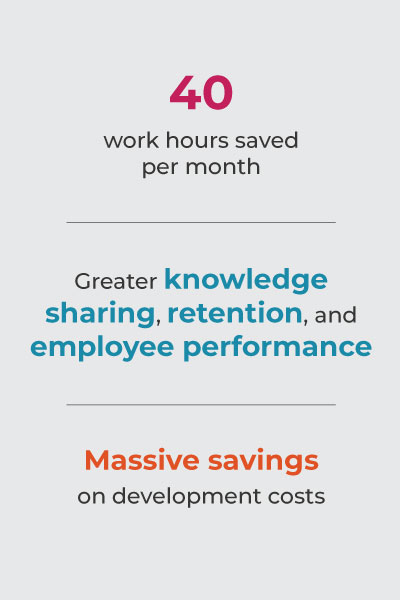
Cost reduction and resource optimization: By streamlining the content creation process, the time and resources required to produce usable content were significantly reduced. This led to massive savings on development costs and an average reduction of 40 work hours per month. With resources freed up, internal teams could redirect their focus toward more strategic learning initiatives, allowing Microsoft to deliver timely and relevant learning experiences at scale.
Enhanced learner engagement and accessibility: The transformation in content delivery led to a dramatic improvement in learner accessibility, engagement, and knowledge sharing. By tagging content to skill taxonomies and segmenting it into AI-generated content, employees were able to effortlessly locate, share, and apply knowledge in their daily workflows.
Improved quality of speaking engagements: The integration of AIQ also elevated the quality of speaking engagements, opening new avenues for enhancing the effectiveness of source content. This alignment with business goals not only improved the relevance of the content delivered but also ensured that it met the evolving needs of the workforce.
Together with GP Strategies and AIQ, Microsoft is pioneering a new training delivery method that is dynamic, personalized, and driven by AI-supported learning.