Picture this: You’re a warranty specialist at an automotive dealership, and a customer just asked about coverage for a 2019 model that’s been discontinued. You need an answer now—the customer is standing right there. Do you excuse yourself for a 20-minute eLearning module? Of course not. You need information that fits the moment, delivered in a way that keeps the conversation flowing.
This is the essence of learning in the flow of work, and understanding when and how to deliver it requires a more sophisticated lens than traditional training approaches offer.
The Three-Dimensional Challenge
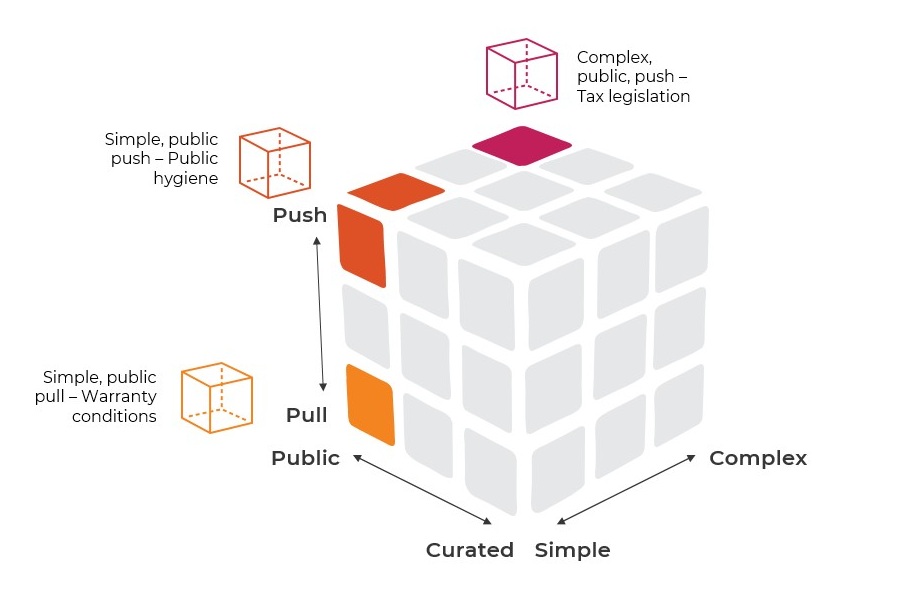
During a recent GP Strategies webinar on reimagining learning performance, learning experience, technology, and consulting experts Ella Richardson, Geoff Bloom, Tom Pizer, and Andrew Joly introduced a framework that helps make sense of why learning in the flow of work feels different across contexts. They called it a three-dimensional matrix—think of it as a Rubik’s cube where each dimension represents a critical variable that shapes the learning intervention.
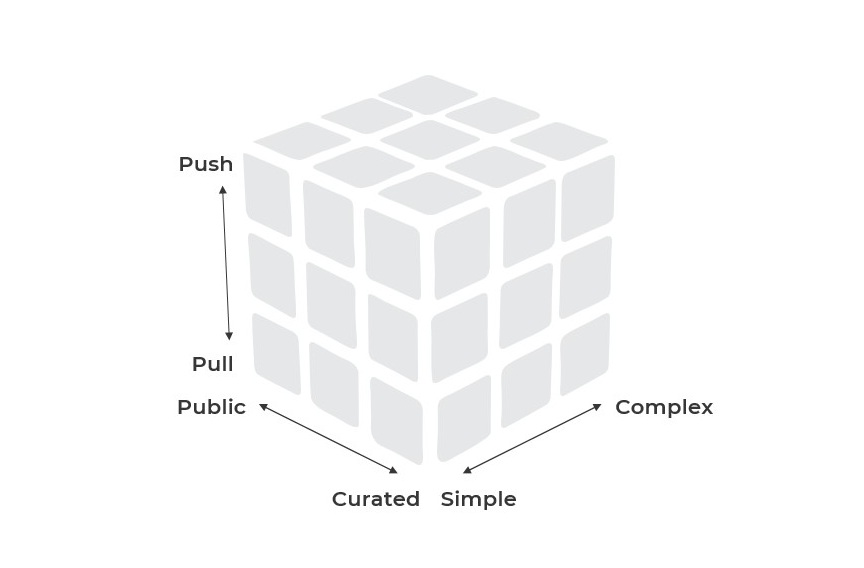
The three axes are:
- Context: Is the information publicly available, or does it come from proprietary company knowledge?
- Complexity: Are we talking about a simple lookup task or complex problem-solving?
- Delivery Mode: Is this information pushed to the learner proactively or pulled when they need it?
What makes this framework powerful is that it forces us to acknowledge that “learning in the flow of work” isn’t a single thing. It’s a constellation of different interventions, each suited to particular moments and needs.
Simple, Curated, Pull: The Foundation
Start at the bottom corner of the cube. Here, the most straightforward scenario is that an employee needs to complete their timesheet or submit an expense report. The information is curated by the organization, it’s relatively simple, and the employee pulls it when needed.
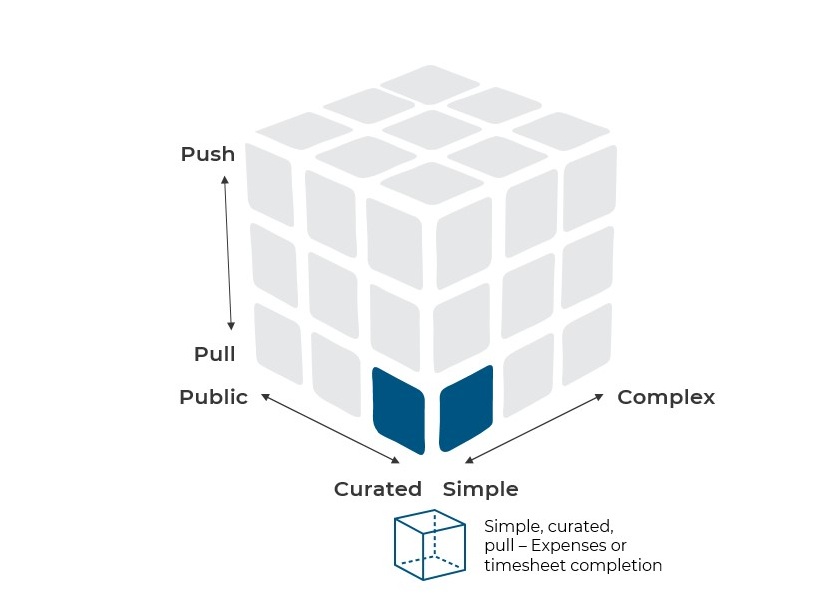
This is the digital equivalent of a well-organized filing cabinet. As Geoff Bloom described it: “I’m a new member of the team. I need to know how to complete my expenses or my timesheet. I need to know it when I need to do it.”
The solution might be a short how-to guide, a quick reference card, or even a brief explainer video tucked into the system itself. The key is that it’s there when needed, unobtrusive when it’s not.
Complex, Curated, Pull: When Simple Won’t Suffice
Move along the complexity axis, and things get more interesting. Consider product maintenance—such as replacing a printer’s heat element or repressurizing a boiler. The information still needs to be curated because it’s specific to your equipment, but a text document won’t cut it. You might need a video demonstration, an augmented reality overlay, or step-by-step visuals.
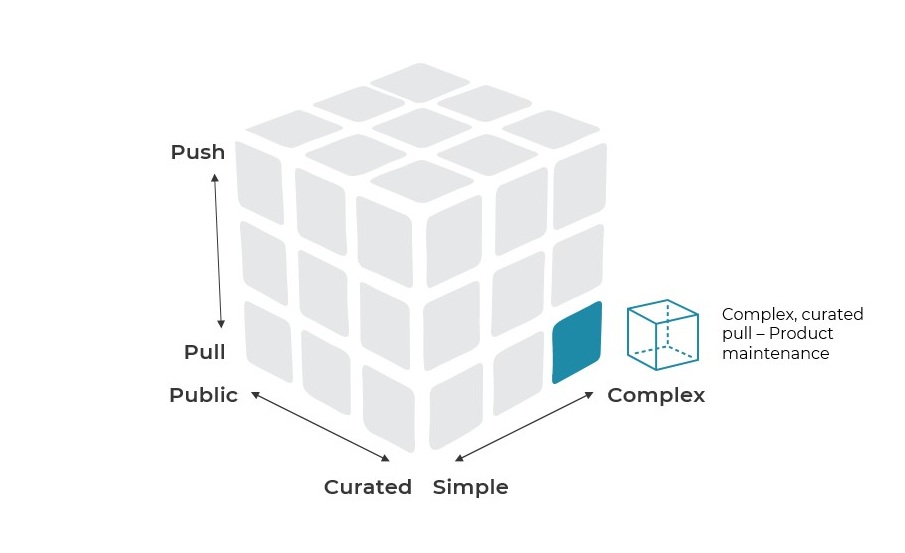
This is where the warranty specialist example comes alive. Imagine giving that specialist a conversational AI companion that understands warranty documentation across multiple vehicle models and years. Instead of cross-referencing dusty manuals, they can have a dialogue with the information itself, asking follow-up questions and getting contextual answers while the customer waits.
As Tom Pizer highlighted, “Wouldn’t it be great if we could give this person a companion, something where they could pull information and have a conversation with the information, really talk to the agent, and have that agent understand what they’re looking for?”
Push Strategies: When Timing Matters
Now consider the push dimension. Sometimes learning can’t wait to be pulled—it needs to find the learner.
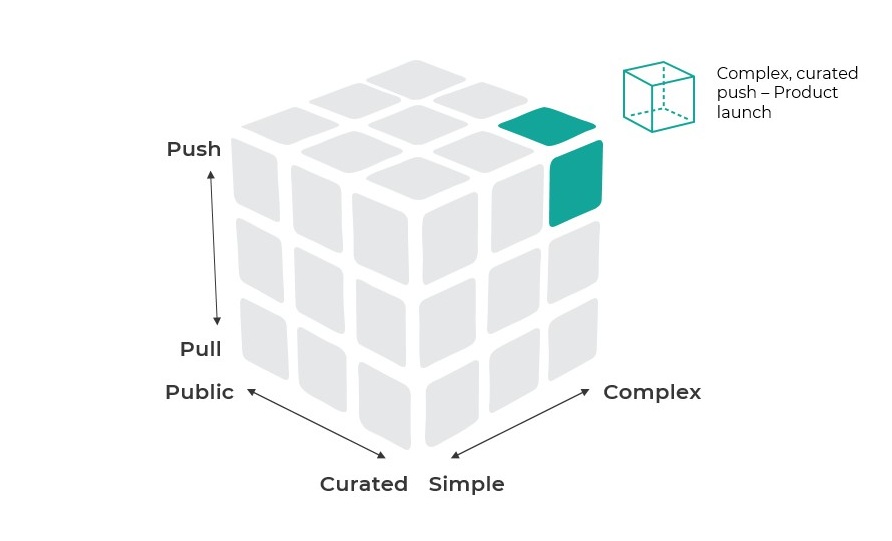
Take product launches. Sales teams are busy selling current inventory, but when a new product drops, they need to know immediately. This is complex, curated information that must be pushed to them in the flow of their work. You’re not interrupting their day; you’re enhancing their ability to serve the next customer who walks through the door.
Or consider simpler pushed information: a product recall, a price change, or a critical policy update. These are the organizational equivalents of a fire alarm—simple messages that need immediate attention.
The Public Side: Learning Beyond Company Walls
The matrix also accounts for publicly available information. New tax legislation is complex and pushed (it’s formulated, documented, and distributed by government agencies), but it’s accessible to anyone who needs it. Public hygiene information during COVID-19 was simpler and pushed broadly because the moment of need was universal and urgent.
Then there’s the simple public pull: warranty conditions you look up only when something breaks, whether you’re advising a customer or you are the customer yourself.
Why This Framework Changes Everything
What Geoff Bloom and his fellow panelists realized during their conversation was that they were sometimes talking past each other about learning in the flow of work because they were thinking about different quadrants of this cube. The solution for a simple curated pull scenario looks nothing like the solution for a complex public push.
This framework helps us ask better questions:
- What’s the complexity of the task at hand?
- Does the organization control this information, or is it publicly available?
- Should we wait for the learner to seek help or intervene proactively?
The answers shape everything, from technology choices to content design to implementation strategy.
The AI Accelerant
Here’s where artificial intelligence transforms the game entirely. As Andrew Joly noted in the webinar, AI plays two critical roles: “One in enabling us to deeply understand the need—the moment of need, when people need something and why they need it. And the other is to help us create the content response…that is entirely relevant, up to date, and matches the user’s needs.”
Consider that automotive example again. The team built an application that integrates live data from other manufacturers’ websites, enabling real-time sales conversations. When a sales professional enters details about what a customer needs, the system provides comparative information, recommendations, and reasoning—all drawn from current market data.
This isn’t creating training that sits on a shelf and ages. It’s building performance ecosystems that evolve with the work itself.
Designing with the Matrix in Mind
The real value of this framework is in what it prevents: one-size-fits-all thinking.
A solution that works beautifully for office workers with laptops might be completely wrong for employees on a production line or in a hospital ward. Someone learning to operate complex military equipment needs very different support than someone checking warranty conditions. The person onboarding to a new system has different needs than the sophisticated user who needs occasional reminders.
As Ella Richardson emphasized, “It’s not about driving people to a new destination. It should be about bringing the learning into where they are.”
The matrix helps us see those distinctions clearly. It reminds us that context is everything, complexity varies wildly, and sometimes we need to push while other times we should wait to be pulled.
The Invisible Design Ideal
Good learning in the flow of work should feel invisible. It should support without disruption, enhance without intrusion. It should feel less like Clippy (that well-intentioned but tone-deaf paperclip from Microsoft’s past) and more like a knowledgeable colleague who knows exactly when you need help and precisely what kind of help would be most useful.
The three-dimensional matrix gives us a map for creating that experience. It helps us plot where each learning intervention belongs in the landscape of work, ensuring we’re designing for relevance rather than redundancy, for performance rather than interruption.
Because in the end, learning in the flow of work isn’t about replacing training. It’s about enhancing performance in the moment it matters most. The matrix helps us figure out which moment, which information, and which delivery method will make that enhancement real.
About the Authors